How Do You Build a Sustainable, Energy-Efficient House in Bulgaria?
Build sustainably in Bulgaria in this order: a compact, south-oriented shape, then a thick insulated and airtight envelope, then a heat pump and solar panels. Insulation comes before technology, because reducing demand is cheaper than producing more energy. I can report this as an architect with 7+ years of experience in Germany, Austria and Bulgaria, as of 2026.
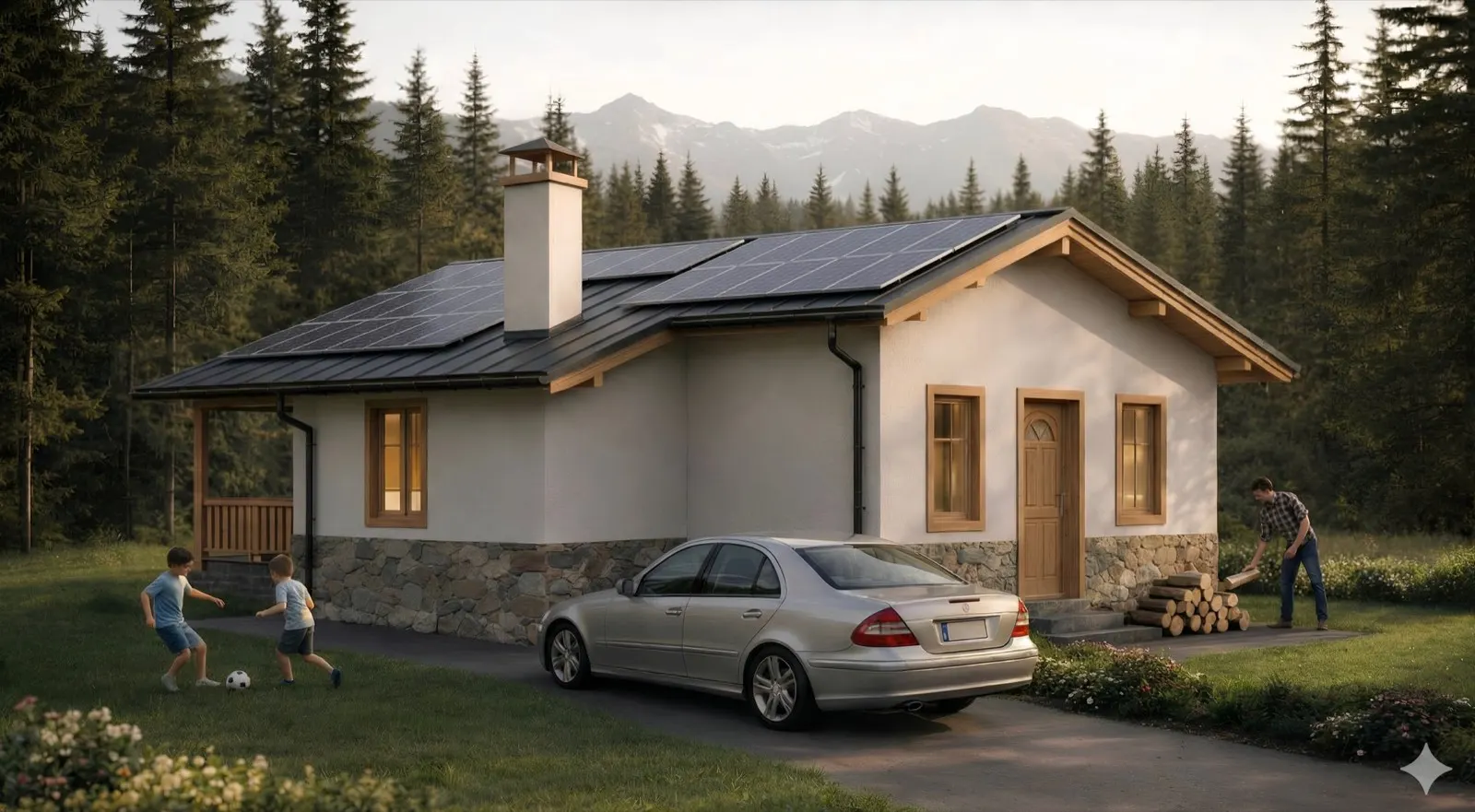
Sustainable building in Bulgaria is mostly good basic design: the right orientation, a well-insulated and airtight shell, honest materials and a small, efficient heating system. Here is how I plan it, in the order that pays off most.
What does sustainable building mean in Bulgaria legally?
Every building in Bulgaria must meet the essential requirements for energy saving, thermal retention and sustainable use of natural resources. The law sets these as basic conditions for any permit.
Buildings are designed, executed and maintained in accordance with the essential requirements, among them “energy saving and heat retention” (икономия на енергия и топлосъхранение) and “sustainable use of natural resources” (устойчиво използване на природните ресурси). — Art. 169 (1) ZUT (Закон за устройство на територията), lex.bg
The legal minimum is the floor. A house built exactly to the minimum is not what I call sustainable.
Is sustainable building more expensive?
Usually 10-20% more at the start, and it often pays back within 5-10 years through lower bills. The extra money should go where it saves most: the building envelope first, technology second.
| Measure | Extra cost (typical) | Payback (typical) |
|---|---|---|
| Thicker insulation | €2,000-5,000 | 5-10 years |
| High-performance windows | €2,000-4,000 | 7-12 years |
| Solar PV (about 5 kW) | €5,000-7,000 | 5-7 years |
| Heat pump | €3,000-5,000 | 5-8 years |
| Rainwater system | €1,500-3,000 | 10-15 years |
These are planning values, not offers. Real prices depend on the region, the house size and the contractor.
What is the most important sustainable choice?
Insulation and airtightness. A warm, tight envelope lowers heating and cooling demand for the whole life of the house, and every other measure works better on top of it.
- Walls: roughly 150-200 mm of continuous insulation, without thermal bridges.
- Roof: roughly 200-300 mm, with air sealing as the critical detail.
- Foundation: perimeter insulation and a thermal break at the wall base.
- Windows: triple glazing or very good double glazing, low-E coating, warm-edge spacer, U-value around 1.0 W/m²K.
- Airtightness: a blower door test below 1.5 ACH50 is a good target; passive house level is 0.6.
Solar panels or insulation first?
Insulation first. A well-insulated house needs a smaller heat pump and a smaller solar system, so you buy less equipment. Bulgaria has a strong solar resource, so PV on a well-oriented roof is a good second step.
How do I design a house passively?
Use the site before you spend money on technology.
- Orientation: put the large windows to the south, shade them in summer with roof overhangs, and keep north glazing small. Utility rooms and storage can sit on the north side as a buffer.
- Thermal mass: heavy floors and inner walls inside, insulation outside. This evens out temperature swings.
- Ventilation: windows on opposite sides give cross ventilation on summer nights and reduce the need for air conditioning.
- Daylight: well-placed windows cut electricity use and make rooms more pleasant.
Which materials are sustainable in Bulgaria?
Local and low-emission ones. Local stone, brick or block, timber from a legal source and lime plaster are easy to get, suit the climate and have a low carbon footprint in transport. Wood and stone have low embodied energy, concrete is medium to high, steel and aluminium are high.
For healthy indoor air I avoid high-VOC paints, formaldehyde-heavy boards and untested imported products. See also my guide on choosing building materials in Bulgaria.
How do I save water and energy in a Bulgarian house?
- Rainwater: roof collection for garden irrigation, sometimes toilet flushing. Plan the tank and pipes during construction.
- Greywater: needs separate plumbing from the start and treatment, so decide early.
- Heat pump: about 3-5 times more efficient than direct electric heating, and it cools in summer. Details in my article on heat pump sizing in Bulgaria.
- Solar thermal: covers a large part of hot water demand and is simple and cheap.
Does the region change the design?
Yes. In mountain areas such as Troyan or Bansko the heating demand and insulation standard are higher, and wood fuel is available. On the coast, around Varna or Burgas, summer cooling, sea breeze and salt-air resistance matter more. In central regions like Plovdiv or Stara Zagora heating and cooling are balanced and thermal mass is valuable.
How do I reduce waste while building?
Design in standard material sizes, order accurate quantities, separate waste on site and reuse cut-offs. In the garden plan, leave space for composting and for waste separation containers.
Can I build sustainably as a self-builder, and do I need a certificate?
Yes to the first. Insulation, air sealing and natural finishes are doable with good supervision. A formal Passive House certificate is optional and rare in Bulgaria. What is mandatory is the energy performance certificate (сертификат за енергийни характеристики) for a new building.
Ready-made plans that suit a sustainable build
My compact plans are easy to insulate and to orient to the sun:
- C-101 (80 m²): compact footprint, low energy demand. View C-101
- C-102 (97 m²): efficient single-storey layout with room for large south windows. View C-102
I adapt either plan to your plot and orientation. If you want a design made for your site, I plan it for you: architectural design. For a first assessment of your plan, book a consultation. All ready-made plans currently include a 5% saving: see all plans.
Follow us on Google Search